
Standard Letter of Evaluation
The Society of Academic Urologists (SAU), in collaboration with the AAMC, is implementing a Standardized Letter of Evaluation (SLOE) pilot for the 2026 – 2027 Urology Residency Match to enhance objective assessment of applicants. The SLOE replaces traditional narrative letters of recommendation with a structured, competency-based evaluation designed to decreased subjectivity, ambiguity and bias. The Urology SLOE introduces standardized, specialty-specific evaluation metrics that enable clearer, more consistent, and comparative assessment of applicants across institutions and will be completed directly in the AAMC Letter Writer Portal.
Letters of recommendation are among the most important components of the residency application, particularly in an era of decreasing objective metrics. The SAU has long explored ways to improve their utility in the resident selection process with ample stakeholder buy-in. Over the past three years, the SAU funded an educational grant and convened a task force to improve the utility of letters of recommendation in applicant review, with a focus on decreasing subjectivity, ambiguity, interrater variability, and bias. Through this work, the task force developed a urology-specific Standardized Letter of Recommendation (SLOR), informed by national survey data. Building on this foundation, the SAU partnered with the AAMC to integrate principles of selection science and further refine the SLOR into the SLOE, resulting in a more rigorous, standardized evaluation tool for the 2026–2027 Match cycle.
SLOE Framework
The SLOE framework includes:
- Standardized Rating Scale: Objective assessment of applicant competencies using defined scales, where meaningful differentiation is expected and not all applicants should receive top ratings.
- Letter Writer Background and Context: Clear description of the writer’s experience and relationship with the applicant.
- Candidate Evaluation Domains: Assessment across key areas such as medical knowledge, teamwork, communication, and professionalism.
- Flexible Authorship: Letters may be authored by an individual or a group (e.g., institutional faculty or clinical teams).
- Narrative Component: Opportunity to provide individualized context in addition to standardized scores.
- Overall Residency Rank: Explicit comparative ranking of the applicant relative to other urology candidates.
Key New Policy Features of the 2026–2027 Match Cycle
- At least 3 total letters are required, 2 of which must be SLOE letters
- SLOE writers should be urologists
- Applicants may submit up to 4 letters
- Individual or group-authored letters are accepted for all formats
- All letters must be submitted electronically through the ERAS/AAMC Letter Writer Portal
We know this pilot represents a significant change in the residency application process, and the SAU and AAMC are committed to supporting applicants, letter writers, and advisors through this transition. As always, we will actively solicit stakeholders’ feedback through applicant and program director surveys, focus groups, roundtable discussions, and other forums to guide ongoing refinement and continuous improvement.
Standard Letter of Evaluation (SLOE)
Thursday, June 18 • 6:30 pm EST

Featuring:
- Dr. Benjamin Breyer (University of California, San Francisco)
- Dr. Richard Lee (Cornell University)
- Richard Peng (Association of American Medical Colleges)
Resources
AAMC Webinar: 2026-2027 ERAS Letter of Recommendation Updates
- Specialty Specific Standard Evaluations: Urology is one of three participating specialties (alongside dermatology and plastic surgery) introducing new specialty designed letters of evaluation formats to support more consistent evaluation practices across all programs and applicants.
- Streamlined Letter of Submission: the ERAS program will now accept all letters of evaluation through a single centralized AAMC letter writer portal to reduce administrative burden and increase comparative data analytics.
- Continuous Evaluation of Pilot Project: the AAMC is continuously evaluating ongoing MyERAS pilot projects such as specialty specific essay questions to provide residency programs with more comparable data and overall transparency
AAMC SLOE Presentation at the SAU at the AUA Meeting
- Access “how to guidance” for applicants to request SLOE and for faculty to complete the SLOE in the Letter Writer Portal
Urology Standardized Letter of Evaluation (SLOE)
- Access the Urology Specialty Specific Evaluation Tool to be completed in the in the Letter Writer Portal
The Urology SLOE at a Glance
F.A.Q.’s
SLOE Format and Using ERAS
| Question | Answer |
|---|---|
| What is the SLOE format? What questions are asked on the SLOE? | This sample PDF demonstrates the prompted questions and content of the Urology Standardized Letter of Evaluation (SLOE). The SAU’s SLOE was developed in collaboration with the AAMC. This SLOE is integrated into the AAMC Letter Writer Portal and intended to deliver a structured and efficient assessment of an applicants’ proficiency in core competencies as well as their qualitative attributes to Urology residency program directors. |
| What is the difference between the prior SAU SLOR and the SAU AAMC SLOE? |
The prior SAU developed SLOR (SAU-Standard-LOR-Fillable.pdf) was created as an effort across prior SAU task forces and grant recipients as a standardized letter of recommendation most commonly used in recent Match cycles to try to reduce bias and standardize LOR content. The PDF was open access, not required and used with variable uptake. The SAU – AAMC Urology SLOE, or standardized letter of evaluation pilot has used this work product as a foundational tool and it has since undergone significant review/revision by AAMC (including their PhD led rigorous selection sciences team) to create a SAU – AAMC Urology standardized letter of evaluation. The SLOE will not be uploaded by PDF but rather completed directly in the AAMC letter writer portal and will allow for a portion of free text narrative. It will allow specialty-based averages for all discrete data elements to benchmark evaluations within the applicant cohort. |
| How do you access the AAMC letter writer portal? | Applicants will generate a letter request via their MyERAS application – at which point authors or their designees will receive an email that includes a request link directly to the AAMC’s Letter Writer Portal. Letters are associated with the email address the applicants sent the request to. |
| Can we have a designee complete the SLOE in the letter writing portal? |
Yes, designees may complete the SLOE on behalf of authors in the letter writer portal. The letter request email an applicant sends to the author includes a direct link to complete the requested letter. This request link can be shared or forwarded to any number of designees; however, only one letter can be submitted per letter request. Once the SLOE has been submitted, the letter is managed by the individual who completed the evaluative form and submitted it in the letter writer portal.
|
|
Will applicants waive their rights to view the SLOE?
|
Yes, applicants may continue to waive their right to view the SLOE as they may do so for any letters of recommendation entry in the MyERAS system. The waived status is labeled with hover text and icons in the PDWS for program reviewers when reviewing applicant letters. This is not specific to the SLOE and more so the broader “global” experience. Applicants will continue to waive their right to view the letter. This status is transparently indicated to the programs not only with hover text but a little “eye” icon. |
| Where are the authors’ names listed under a joint letter? Does the name of the person who submits the letter come up differently on the letter? | The author’s name and background are listed at the top of the SLOE under the “Evaluator” section. Additional letter authors that have been listed in the group letter question, will also be displayed under the “Evaluator” section of the SLOE for programs to view. The designee or individual who submits the letter is not displayed on the SLOE unless if they are listed as a primary author or additional author. |
SLOE Requirements and Policies
| Question | Answer |
|---|---|
| What are the policies surrounding the SAU SLOE Pilot? | *See table below |
| Does Urology require a Department Chair letter? Can the SLOE be identified as a Department Chair letter? | There is no specific requirement for a Department Chair letter in urology although it is common practice.
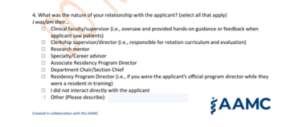
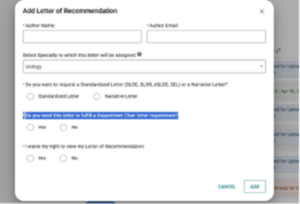
When applicants generate a letter request, they may indicate if the letter fulfills a “Department Chair Letter requirement”. This will render in the programs view so that they may quickly identify department chair letters. The author may also indicate their role in the SLOE via the writer background question: “4. What was the nature of your relationship with the applicant?” Multiple author types may also be selected for group letters. Please review the sample PDF for prompted roles.
|
| Should the Department Chair or Program Director letter be a SLOE? | The 2 required SLOEs must come from urologists but do not need to be from either a Chair or Program Director. However, we encourage Chairs, Program Directors, and any academic urologists to write SLOEs, as it was designed as a standardized tool for evaluation of urology residency applicants. |
| Is department chair interchangeable with head of division? | Yes, Urology Department Chairs and Urology Division Chiefs are interchangeable for purposes of a LOR/SLOE |
Urology 2026-2027 Application Cycle Letters of Recommendation Policies
| Area | Guidance and Policy |
|---|---|
| Number of Letters | · Total letters required: 3 (you may submit up to 4 letters maximum).
|
| Letter Types | · Required letters:
o At least 2 Urology SLOEs (both from Urologists) o 1 additional letter, which can be any of the following: a traditional (narrative letter), a prior version SLOR (PDF format), or a general standardized letter (no specialty requirement). · Optional letter: o You may include 1 extra letter (to reach the 4-letter maximum) that can be either a narrative letter or a general standardized letter (no specialty requirement). |
| Author Type | · Individual (or group) that observed performance.
· At least 2 letter writers must be Urologists. · It is highly recommended (although not required) that the home program and/or away program letters be submitted via the new Urology SLOE. |
| Format | · All letters must be uploaded electronically through the AAMC Letter Writer Portal
o Urology SLOEs are directly completed and submitted via the letter writer portal (no PDF upload). o Traditional (narrative) letters or prior version SLORs are uploaded with a PDF upload process. |
FAQ for Letter Writers
| Question | Answer |
|---|---|
| If we are writing a joint letter with another faculty member, (APD with chair letter for example), does it matter who the applicant puts as the author request?
Should students select chair letter for this or not? Is there a requirement for SLOEs from Chairs or just SLOEs in general? |
If the Department Chair will be one of the letter authors, please have the applicant designate Chair.
There is no requirement for Chair letters, and Chair letters do not need to be SLOEs. However, we encourage Chairs, Program Directors, and academic urologists to write SLOEs. |
| May students send letter requests to Program Coordinator’s email addresses? | Yes, if that is how the program has requested the student submit the letter request. The Program Coordinator can submit the letter as the designee for the letter authors. |
| How do we know if a student has assigned us a letter? Do we get an email notification? | Yes, you will receive an email invite. |
| If the applicant requests a SLOE or a narrative letter, and I would like to write the other type of letter, how do I write the other type of letter? | You would have to ask the student to change the letter type. You cannot upload a narrative letter if the student has requested a SLOE, and vice versa. |
| Does the SLOE have to be entered into the online template, or can the SLOE letter be completed beforehand and then uploaded as a PDF file? | The SLOE will need to be entered into the online template. It cannot be completed beforehand and uploaded as a PDF. PDFs uploaded will be counted as narrative letters, even if they are written on the SLOE template. |
| If we are writing one letter (SLOE) for students completing an away rotation that represents the department including the PD, clerkship director and chair, what does that letter look like technically? | The SLOE can be submitted with multiple co-authors listed. One person (one of the authors or a designee) can submit the SLOE template under multiple co-authors. |
| If a letter is designated as a department chair letter but also has multiple authors, does the chair have to submit the letter or can any author submit? | Any author or designee can submit on behalf of the chair and the authors. |
| Should the SLOE identify how many Urology rotations were done by the student prior to the rotation evaluated? It would help explain if there were a disparity in a students evaluation for a first rotation in May /June vs a seasoned student September | There is a question in the letter writer section in which the author indicates when the student rotated with them. This is available in the final letter and can be considered when reading the letter. |
| Do joint letters carry more weight than single authors? Would you recommend joint letters if possible? | There is no indication that joint letters are more advantageous than single author letters. If the workflow for a specific program is a joint letter, then that should be utilized. |
| What are the time period of requesting and finally uploading the letter given? | There is no deadline after receiving a request for a letter of recommendation. However, programs will be able to start reviewing applications on September 23rd at 9 am eastern time. Letters submitted after this date may be missed by programs. |
| Can you decline doing any letter? | Yes. A request from a student is not binding. |
| Are letters due on September 2nd or September 23rd? | There is no due date. Programs can start accessing applications and LORs on September 23. Students can start applying to residency programs on September 2nd, but the applications are not unveiled to the residency programs until September 23rd at 9 am EST. |